
Andy Mossack offers his insider Guide to Gujarat and shows just why this often-overlooked state is an absolute must to visit. And not just because of its ancient stepwells and Asiatic lions.
It’s late afternoon in the Gir National Park and as our safari jeep rounds a bend the driver hits the brakes. Blocking the road ahead sitting sunning themselves is a pride of twelve Asiatic lions. It’s a full-on Attenborough moment and for once I’m speechless. We sit in silence gawping at these magnificent beasts, the very last of the species that once fought gladiators in ancient Rome.
But we’re getting a little ahead of ourselves.
Gujarat is a state lying along the western coast of India stretching almost 2,400 kms, the longest state coastline in India. Despite this, it’s a road less travelled by most tourists preferring the well-worn Golden Triangle treadmill of Delhi, Jaipur and Agra. Yet mention Gujarat to those in the know, including Indians, and you’ll get a smile of acknowledgement. It’s an absolute jewel. The food, the history, the textiles, the famous stepwells and let’s not forget the Asiatic lion, the Blackbuck and the Wild Ass found nowhere else in the wild.
In this insider guide to Gujarat you’ll find out just why it’s such a special place to pick on your next visit to India.
Ahmedabad
Gujarat’s largest city and India’s first UNESCO World Heritage City is an excellent place for us to start. Nicknamed the ‘Manchester of the east’ for its world-class cotton and textile production, it was a magnet in the middle ages for wealthy merchants and mill owners and to this day is India’s second largest producer of cotton.
Take a stroll through the old quarter and travel back in time to see many trappings of its wealth. Manekchowk Square transforms daily into three guises. In the mornings it’s a lively vegetable market, in the afternoon it becomes a huge cash-only gems, gold and silver exchange, while at night it’s a culinary hub for street foodies staying open long into the early hours. The daily street fish market is also a sight to behold. Sea creatures of all types, sizes and shapes, and no shortage of customers.


The massive 15th century Bhadra Fort built by Sultan Ahmad Shah the founder of the city once covered 43 acres housing royal palaces, mosques and the Bhadrakali Temple of the Hindu Goddess ‘Bhadra. It continued to be a fearsome fortification through the centuries until the British took the city in 1817 and used it as a prison throughout the days of the Raj until independence in 1947.
Don’t miss Mahatma Gandhi’s former home, the Sabarmati Ashram, the focal point of the freedom struggle and where he began his historic 240-mile Salt March in 1930. There’s an excellent exhibition here chronicling his life and death and you can visit his spartan house where he held meetings with dignitaries – simple rooms with just bare walls and mats, his iconic spinning wheel still in residence. I found it a deeply moving experience.


There are some remarkable ancient temples and mosques in Ahmedabad. From the 16th century Sidi Saiyyed Mosque with its stunningly elaborate tree of life carving on its back wall – the unofficial symbol of the city – to the quite breathtaking Jain Hutheesing temple and its painstakingly intricate masonry created by the city’s finest craftsmen.
Local chai stop: Check out the Lucky Café opposite the Sidi Saiyyed Mosque, a local hang out for excellent masala chai and bun-maska bread rolls. It was often frequented by M.F. Hussain a famous Indian artist and film director who donated the painting that is proudly hanging on the wall. Check out the tree growing through the centre of the cafe!
The House of MG is a perfect base, right by the old city. With over a century of colonial history behind it, the mansion is still owned by a member of the Mangaldas Girdhardas family who were once probably the wealthiest and most influential merchants in the city. Beautifully restored to its turn of the century grandeur, this is a colonial landmark property with character seeping from every crevice. Check out the art deco indoor pool!

Ahmedabad Dinner Recommendation: Vishalla. For an exceptional taste of authentic Gujarati cuisine, Vishalla is quite the experience. Part kitchen utensils museum, part theatre and part restaurant, get here an hour before you want to eat so you have time to explore this unique experience. Set across a sprawling plot of land, the museum has thousands of utensils dating back centuries, there is live folk music and dancing, animals and puppetry, and all of it capped by a delicious bottomless thali fest served on banana leaf plates using ingredients sourced fresh every day from local farmers.
Giant Stepwells and the Sun Temples of Modhera
Just a few miles out of Ahmedabad within a park in Adalaj you’ll find this outstanding example of one of Gujarat’s famous stepwells. Built in 1498 it’s a huge structure some seven stories deep and festooned with intricate carvings of Hindu and Jain gods. Reputed to be where Rani Roopba, a captured queen, drowned herself rather than marry her husband’s conqueror, having first convinced him to build this glorious structure.
If the story is true, it’s a fitting and lasting tribute.
Being a largely semi-arid state, Gujarat’s stepwells, fed by springs and topped up during monsoon seasons, were critical for providing fresh water for drinking, bathing and washing. They became meeting places for local women to chat while washing clothes and they also provided rest and refreshment to caravanserais travelling the spice and silk routes.


An even more elaborate and much older example is Rani Ki Vav or Queen’s Stepwell, in the town of Patan. This is a huge structure and perhaps the finest of all in Gujarat. Constructed in the 11th century it is over 200 feet long and 92 feet deep and filled with over 1,500 intricately carved sculptures.
It’s well worth summoning the courage to climb down the steep steps here and simply marvel at the stonework. And you’ll get a good work out on the way back up! This is a wonderful example, but it’s just one of many, there are over 100 stepwells throughout Gujarat well worth discovering.
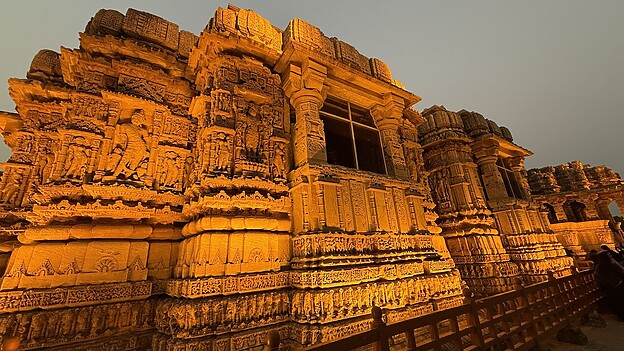
Not far from this stepwell, in the village of Modhera, lies The Sun Temples, an extraordinary 11th century Hindu temple complex of outstanding beauty dedicated to the sun god Surya. It is one of the crowning achievements of the Solanki dynasty, and getting there at sunset makes it even more magical. Ornate stone carvings abound, on pillars and across the walls and ceilings.

There are three parts to the complex, the shrine hall, the assembly hall, and the Kunda, a huge rectangular stepwell. As the light fades the spotlights turn on and turn the whole complex into an ancient wonderland of light. A truly mesmerising experience.
Dasada and the Little Rann of Kutch Safari
Leaving the city behind, we’re deep into the countryside now to immerse ourselves in Gujarat’s famed wildlife. The Rann of Kutch (Rann is desert in Hindi) is 10,000 square miles of salt flats that span the borders of Pakistan and India, however most of it is in Gujarat in the Kutch district, hence the name.
It was once part of the Arabian Sea which drained away to leave this saline wilderness of dry, flat and cracked salted mud, scrub and grassland, seemingly stretching forever. In the hot summer this is an epic land of crusted mud, but come winter, post monsoon, it floods into a wetland haven for 350 species of birdlife including eagle, kestrel, pink flamingo, pelican, stork and crane.
There are two Rann Kutch’s, the Greater Rann running east and west and its smaller sibling the Little Rann which stretches south, and this is where we’re heading to find the Asiatic wild ass a remarkable endemic animal that has adapted and thrived in these harsh conditions.


The village of Dasada and specifically Rann Riders Safari Lodge is my base gateway into the Little Rann. Despite the name sounding like characters from a Star Wars movie, it is a very comfortable lodge just outside Dasada and this morning I’m on a very early jeep safari with a ranger guide into the Wild Ass Wildlife Sanctuary, the last place on earth to see these beautiful animals in the wild.
And It’s not long before we find them. Small herds of wild ass, chestnut coloured with the trademark black stripe running down their backs and looking like a cross between a zebra and a donkey. They look serenely untroubled and it’s hard to believe they’ve become an endangered species. Out here we’re alone with nothing but birdsong to listen to. It is a stunningly remote land. Otherworldly and beautiful at the same time.
We park close to a giant monsoon-made lake filled with pink flamingos and enjoy a delicious jeep bonnet breakfast before heading back to the lodge.
Blackbuck National Park Safari, Velavador
I leave Little Rann’s saline landscape, and a 3-hour drive takes me to the golden savannah grassland of the Blackbuck National Park not far from the Gulf of Khambhat. This is the domain of the native Blackbuck a beautiful animal, particularly the males, with their distinctive long corkscrew horns and two-tone fur.
My base is the Blackbuck Safari Lodge, a comfy rustic retreat on the park perimeter surrounded by natural forest and offering really tasty local food.

The weather forecast is rain, not perfect in an open top jeep, but it’s still warm, and the wet weather doesn’t deter the wildlife who seem to savour the refreshing showers. Plenty of headlining Blackbuck on show and some impressive supporting acts including the blue bull, Asia’s largest antelope, the Indian wolf, striped hyenas and some extraordinary birds including plumpy nightjars sitting fast asleep on the trackside unperturbed by our jeep rolling past inches away.
Dared Tree of Life Darbargadh
With a long drive ahead of me to my final safari experience at the Gir National Park, I take a couple of nights rest and relaxation at Tree of Life Darbargadh. This magnificent 17th century fort was the former home of the Dared royal family and is now a beautifully restored luxury boutique hotel. It’s the perfect way to unwind after some pretty long drives.

Surrounded by centuries of history, there are some wonderful traditional touches here. A full ceremonial welcome complete with banging drums, petals, incense and a foot massage. A romantic canopied high tea sundowner by the banks of the Ghelo River in the royal estate’s orchard where as the sunset bloomed red, my wife and I felt suitably regal. And a guided stroll around the village, meeting the local artisans, dodging cattle and watching daily life unfold. Tree of Life Darbargadh is a very special place.
Utterly unmissable.
Sasan Gir National Park Safari
It’s a dusty five-hour drive from Dared, but along the way the landscape change is dramatic. The sweeping savannahs have been replaced by hilly tropical forest and my final destination is finally in sight, Gir National Park the last domain of the wild Asiatic lion.
Set up in 1980 to protect the lions and their habitat, numbers have thankfully grown from just 32 to now more than 890. The success of the park has naturally increased visitor traffic and after being in serene isolation for so long, it was strange to be caught up in the trappings of tourism. Hotels and lodges line the route into the park but once inside the gates, everything is strictly controlled to protect its precious habitat.

Ranger driven jeeps are the only vehicles allowed to drive through the main tourist section of Gir, and each have set routes to offer guests. A little bird told me route 6 is the best one for sightings and fortunately I manage to bag one (with a little help). There are man-made water holes built near the trails so the animals will be drawn to drink there in the hot dry months, but post monsoon there is no lack of water anywhere, so my hopes of lion spotting are not high. Plus, the vegetation is lush and green, so it’s harder to spot anything in the undergrowth.
In the end though good old route 6 pays off. The ranger’s radio crackles with news of a sighting, and we make our way to the spot, turn off the engine and wait. It seems a certain type of call from a deer signals a threat warning across the forest. One for lions another for leopards. It doesn’t take long. Just 15 minutes later two young male lions stroll together across the trail in front of us. “They’re the new leaders of the pride since the old king recently passed away” whispers a ranger.

Which leads me rather perfectly back to our original lion roadblock. It was a tip-off from a passing ranger apparently, but our rangers kept it from us as a surprise. After watching the cubs play and the adults chill right in front of our eyes for a good half hour, it’s time to leave as the park is closing. The only way past is to drive very slowly between the lions lying on the road and others just to one side in the forest It is a heart in mouth moment and one I will never forget that’s for sure.
The Woods at Sasan Resort
Far away from the touristy hotels, The Woods at Sasan is undeniably a class act. A serenely luxurious and spiritual retreat bordering the Gir that not only represents and celebrates the environment and the fantastic craftmanship of local artisans but is 100% sustainable. Beautiful lodges using wood from a local shipyard for the handmade furniture. Two outstanding restaurants with the signature one specialising in local Gujarati cuisine. The SOM spa is outstanding and for me, the SOM Sonorium sound bath experience was unforgettable.


A fitting finale then to my Insider Guide to Gujarat. But let’s not forget, there are many more aspects to this region which can easily be accessed through specifically curated tours. Like taking a deeper dive into its rich textile industry, explore its historic royal palaces, uncover its ancient past or simply indulge yourself in glorious food and spices.
Gujarat is waiting to seduce you, just give it a try.
All images (C) Andy Mossack except Woods at Sasan reception.
Tell me more about this Insider Guide to Gujarat.
Experience Travel Group
This Insider Guide to Gujarat forms part of Andy’s epic Indian Odyssey series, which was curated in collaboration with Experience Travel Group, experts in creating bespoke travel across Asia and beyond. If you want to follow in any of Andy’s adventurous footsteps in India or curate a different Asian experience for yourself call them on 0203 993 2054 or visit Experience Travel Group
Getting to India
Throughout his Indian Odyssey series Andy flew with Air India. A direct flight from London Heathrow to Delhi, from Delhi to Ahmedabad, Rajkot to Kochi and Kochi to London Heathrow via Mumbai..
If you enjoyed this review, why not check out these similar posts:
 Ginger House Museum Hotel, Kochi, India. A museum stylishly blends with a unique boutique hotel in Southern India
 Guide to Strasbourg. Unmissable hidden gems to discover.
 Insider Guide To Coastal Karnataka. Where India’s majestic mountains meet endless beaches.
 K Gudi Wilderness Camp. Discover ecotourism heaven in southern India


A fabulous insight into the Gujarat world and what wonderful pictures . Well done Andrew once again. Looking forward to the next installment of “Andy’s Epic Indian Odyssey”
Thankls for the kind words Jeff. Always good to get feedback both good and bad. Yup, next one on the list is Rajasthan, coming next week! 🙂